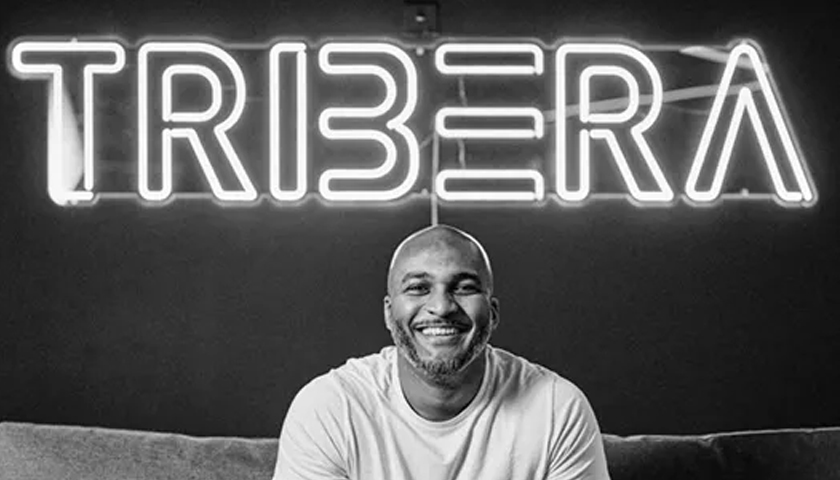
As Cannes Lions 2026 prepares to award the first ever AI Craft Lion – requiring entrants to prove human creativity was essential to the work – Dré Picart, Managing Partner and co-founder of award-winning Birmingham agency Tribera, says the decision confirms what the industry has been slow to admit: AI without human conviction doesn’t produce better marketing. It produces more of the same.
Dré, whose agency was recently named one of Campaign’s Best Places to Work 2026, made the argument in a recent keynote at The Marketing Meetup, warning that the widespread adoption of generative AI has not delivered the creative liberation it promised. Instead, he argues, it has produced a profession in retreat – more prolific, more risk-averse, and increasingly indistinguishable from itself.
“Cannes Lions introducing an AI Craft category is an admission,” said Picart. “It’s the industry’s most prestigious stage telling us the work that wins must prove a human was essential. That’s the industry’s most prestigious stage drawing the same conclusion. We’ve created a sea of same – and we’ve mistaken volume for value.”
His comments arrive as the festival, which runs 22–26 June in Cannes, also introduces a new Creative Brand Lion, recognising the internal cultures and capabilities that produce consistently outstanding creative work. A move Dré describes as further evidence that the industry knows craft is under threat.
The deeper wound
Dré’s argument goes beyond the quality of AI output. His central claim is that the technology has made the humans behind the work more timid, not more free.
“We used to be mavericks,” he said. “Now we’re paralysed. Paralysed by the fear of standing out, of it not working, of doing anything an ROI dashboard can’t explain. AI gave us infinite tools to execute and almost no permission to be interesting.”
He points to Kantar’s Media Reactions 2025 report, which found that 57 per cent of consumers now worry about fake or misleading AI advertising, as evidence that audiences are not only noticing the creative decline – they are losing trust because of it.
“Marketing has a new problem,” said Dré. “It’s no longer hard to produce. It’s hard to matter.”
The 10/80/10 rule
In response, Dré sets out a working framework he calls the 10/80/10 Rule: 10 per cent human input at the start – the cultural insight, the point of view, the brief no model could write – followed by 10 per cent machine in the middle for drafts, variations and production, and 10 per cent human at the finish to edit, sharpen and make the work distinctive.
“Skip the first ten per cent and you’ll publish slop,” he said. “Skip the last ten per cent and you’ll publish someone else’s slop. The human value isn’t what’s left over when AI is done with the work. It’s what AI can never start.”
The framework directly aligns with the criteria Cannes Lions has set for its new AI Craft Lion, which states that eligible work must show the core concept, execution or impact would not have been possible without AI – but also could not have existed without human creative direction.
Four things only humans bring
Dré identifies four qualities he argues are irreplaceable in effective marketing, which he calls the Four Ts: Taste, Truth, Trust and Tension.
Taste – the ability to identify which of a thousand AI-generated options is right – is a judgement call no model can make. Truth refers to stories grounded in lived human experience, rather than synthesised plausibility. Trust addresses the growing consumer backlash against AI-generated advertising, and the competitive advantage available to brands that visibly put humans at the centre of their communications. Tension is the willingness to hold a point of view sharp enough to polarise – something the algorithm, optimised for engagement and consensus, will never volunteer.
“The algorithm doesn’t pick the brave idea,” said Dré. “That’s not a criticism of the machine. It’s an observation about what happens when you let it lead.”
He closes with a quote from advertising legend Bill Bernbach – “You’ve got to say it in such a way that people will feel it in their gut. Because if they don’t feel it, nothing will happen” – as a reminder that the fundamentals of effective marketing predate, and will outlast, any technology cycle.
For more information on Tribera and its services, visit here.