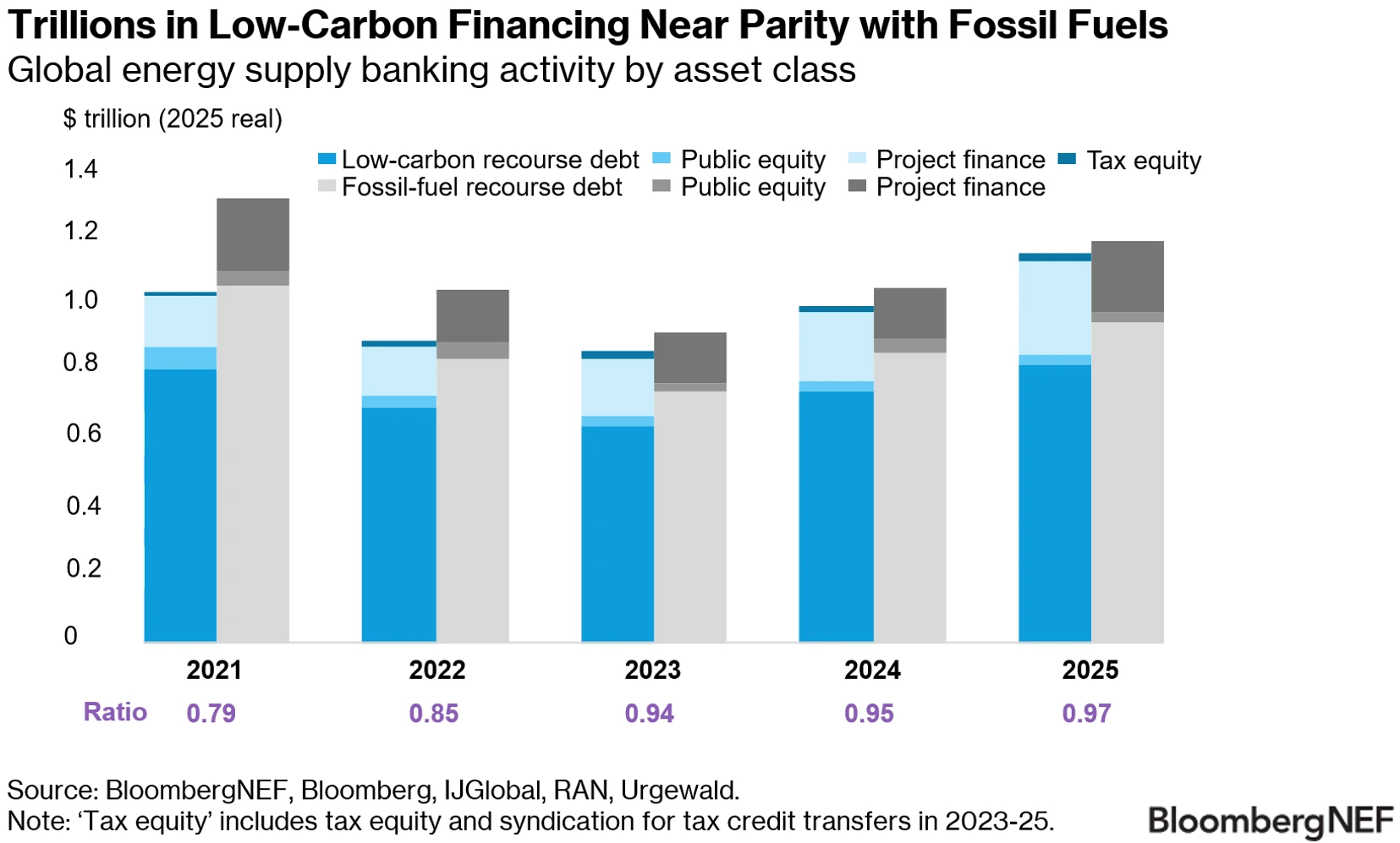
Global banks arranged $0.97 of low-carbon energy supply finance for every dollar of fossil-fuel financing in 2025, according to BloombergNEF’s latest Energy Supply Banking Ratios report. That ratio marks a gradual improvement from 0.95:1 in 2024, but remains far below the average 4:1 Energy Supply Banking Ratio (ESBR) needed this decade to align with climate goals.
Despite a shift toward low-carbon energy, fossil-fuel investment still rose in aggregate terms. Elevated oil and gas financing among the trillions in recourse debt, public equity, project finance and tax equity tracked by BNEF pushed fossil-fuel volumes up to $1.19 trillion. Low-carbon financing grew faster, however, reaching a five-year high of $1.15 trillion, boosted by grid financing.
The ESBR has been adopted by more major North American banks this year, even as their financing has broadly shifted toward fossil fuels. Bank of Nova Scotia and the Royal Bank of Canada joined JPMorgan and Citi in disclosing their own versions of the ratio. The Canadian Imperial Bank of Commerce also published a methodology this year and has yet to publish a ratio. Greater disclosure may be the first step toward further action on the ratios, even as many non-disclosing banks continue to post year-on-year improvements.
1. Largest banks shifted back to fossil fuels
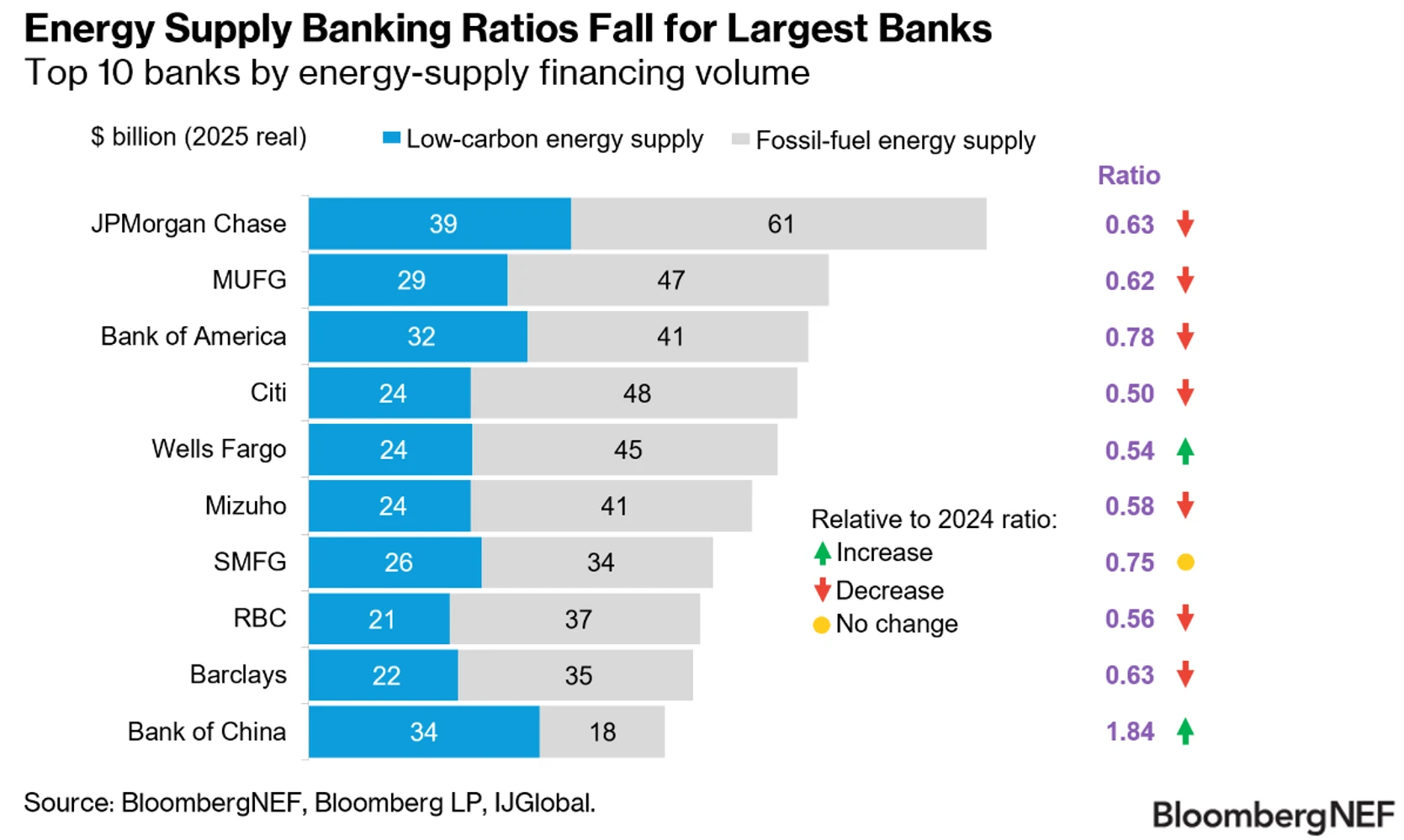
The largest banks by energy-supply financing volume remain predominantly fossil-heavy.
JPMorgan Chase was the largest bank by financing volume with about $100 billion in 2025. Its ratio fell to 0.63:1 due to rising fossil-fuel financing in the US and a slight drop in low-carbon financing. MUFG ranked second with $77 billion. The bank’s ratio also fell following greater fossil-fuel activity, particularly in the US.
Bank of China was the institution with the highest ESBR in 2025 among the list of biggest banks, with a ratio of 1.84:1 – rocketing up from 1.04:1 in 2024. It is also the only top 10 bank that has experienced sustained year-on-year improvements in its ratio, up from just 0.58:1 in 2021. Grid financing has been the main source of the upward momentum and will likely continue to lift its ESBR. China’s largest grid player, State Grid Corporation of China, has already issued an additional $61 billion in debt through the first half of 2026. As a main facilitator of this debt, Bank of China’s involvement should keep its ratio elevated.
2. China and Europe tilt low-carbon, North America backs fossil fuels
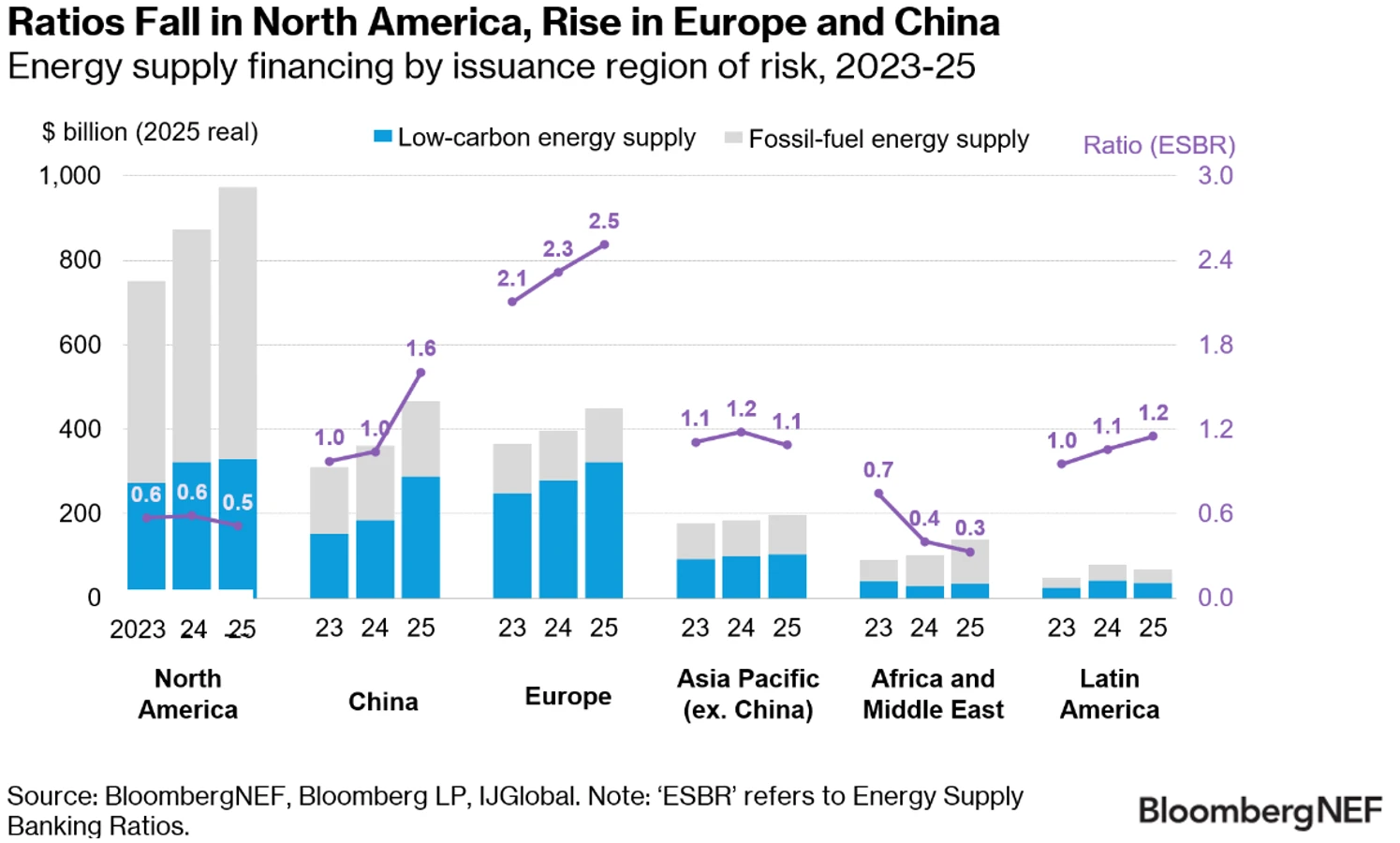
China’s ESBR jumped to 1.6:1 in 2025, as grid financing surged; State Grid Corporation of China issued over $105 billion in grid financing in 2025, up $67 billion from 2024. Oil and gas financing volumes declined, amplifying the ratio’s rise.
Europe retained the highest ESBR of any region, rising to 2.5:1, from 2.3:1. A 75% year-on-year growth in financing for wind projects boosted its ratio, largely from offshore wind project finance.
North America moved in the opposite direction. The region remained the largest market, with financing rising to $973 billion, but most of the increase went to fossil fuels. Fossil-fuel financing increased by $92 billion, compared with only $8 billion for low-carbon financing. This pushed the region’s ratio down to 0.5:1 in 2025, mainly driven by activities in the US. Financing in the US for companies with coal-related revenue exposure increased to record levels, at $42 billion.
3. Capex reveals low-carbon financing tilt
When adjusting ESBRs on company capex rather than revenue, bank financing begins to tilt low-carbon. The capex-based ratio sits at 1.32:1 in 2025, higher than the 0.97:1 revenue-based result. Under this view, banks have facilitated more low-carbon than fossil-fuel financing every year since 2022. While revenue reflects past investment decisions, capex highlights business model shifts and investments – reflecting the ongoing energy transition.
Utilities are responsible for a significant portion of this change. The capex-based ratio among deals for utilities issuers reached 3.0:1, compared to a 1.59:1 revenue-based ratio in 2025. The shift is particularly strong for utility issuers in China and Europe, benefiting banks with strong exposure in these markets. Deals for Chinese utilities aggregate to a capex-based ratio of 12.7:1, far above the 4.24:1 under the revenue approach.