|
Marketing is operating in an age of abundance. Today’s consumers face more content and choices than they have the attention or means to manage. AI agents are emerging as fundamental tools to help consumers cut through the noise and make decisions faster. New research by PHD in partnership with WARC reveals how quickly they are reshaping the customer journey.
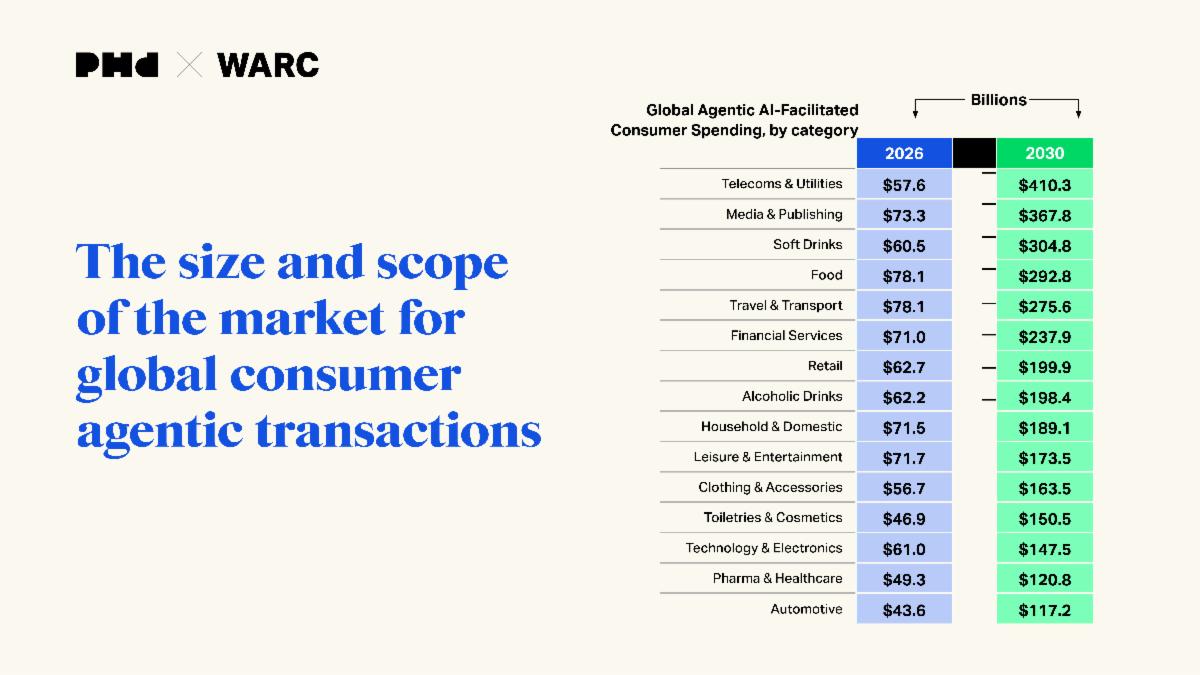
The study finds that total agent-facilitated consumer spending will triple from $944bn this year to $3.35trn in 2030. While consumers will still make most purchase decisions on their own in the next few years, AI agents will increasingly shape what gets seen, shortlisted and bought – and will increasingly mediate the boring, complex or repetitive tasks along the way.
As decision-making increasingly evolves from human consumers to machine intermediaries, this study explores the scale, timeline and implications for brands, agencies and the wider marketing ecosystem.
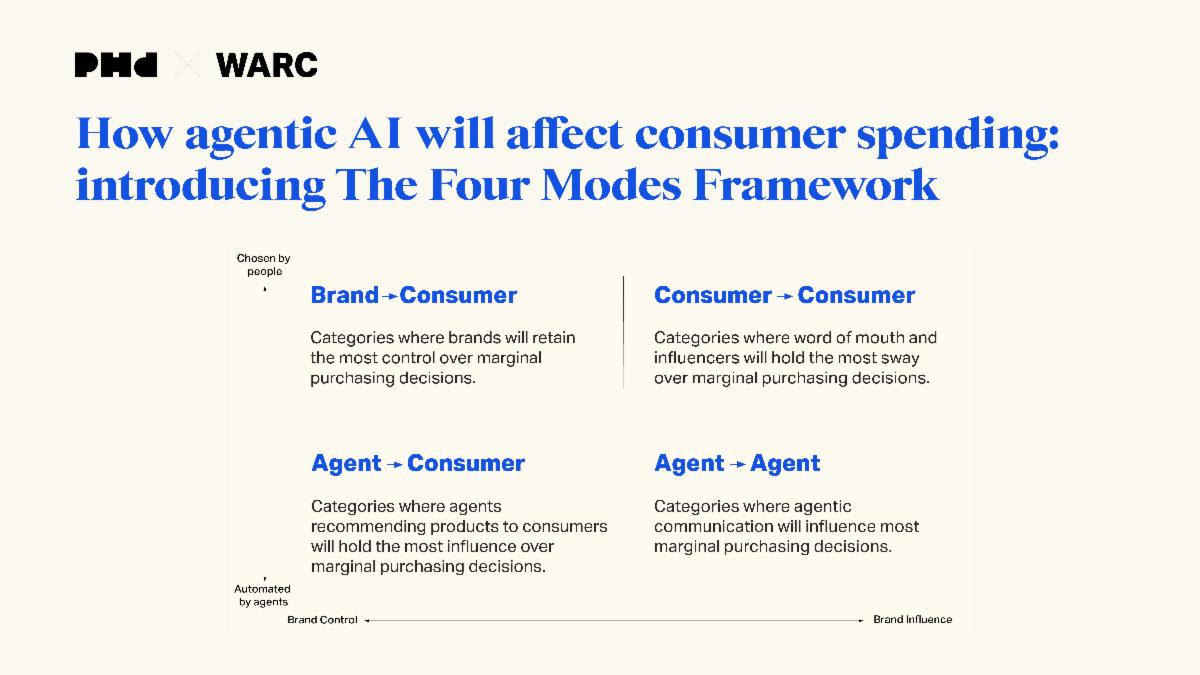
Rohan Tambyrajah, Worldwide Chief Strategy Officer, PHD, says: “This research brings category level empiricism to the open-ended industry conversation about the growth opportunity with consumer facing AI and Agentic AI. It underscores the need for brands to design for both meaning and machine logic, and through Four Modes Framework offers marketers practical guidance on how best to implement against a category-level business case.”
James McDonald, Director of Data, Intelligence & Forecasting, WARC, and author of the research, says: “This landmark study finds that agentic AI is already facilitating the path to purchase for many consumers, and will become deeply embedded over the coming years to influence $3.35trn in household expenditure by 2030.
“This is true not just in high-frequency categories such as travel, CPG, and utilities, but increasingly more so in sectors that have traditionally leveraged brand marketing as a core strategy. By mapping adoption across product sectors, markets and media, our research ensures practitioners are not caught flat-footed as they approach the new frontier.”
Methodology of the research
The research draws on data provided by Acxiom and uses a weighted index approach to evaluate key factors such as decision complexity, transaction value, purchase frequency, data availability, media mix, and market regulation to make a holistic assessment of how much consumers will spend on AI channels in 2026 and 2030. The analysis covers the global viewpoint of ten markets: Australia, Brazil, China, France, Germany, India, Mexico, South Korea, UK & US. Additionally, it includes industry expert views and category analysis.
Key findings from the research outlined in ‘From abundance to agents – how the delegation of choice is transforming marketing’ are:
Categories and markets leading on agentic AI consumer spend
Agentic AI – artificial intelligence systems that understand goals, plans steps, and act autonomously – are making their mark on high-frequency categories like travel & transport, food, and media & publishing. By 2030, AI-facilitated spending will surge across all industries, especially where purchases are frequent and data-rich.
|