|
The “Twin Pace” Effectiveness Gap is a new survey-led study by WARC, the global authority of marketing effectiveness, that looks at the forces shaping today’s effectiveness culture in APAC.
Drawing on fresh and original survey data from senior marketers and agency leaders, the research
provides the first quantified diagnosis of why effectiveness principles are widely understood yet
inconsistently applied in practice across the region.
Closing this gap requires governance, not just marketing intent. Organisations need to redesign decision rights, evaluation windows, and success metrics so brand investment can be justified alongside performance — enabling teams to operate at twin paces rather than defaulting to short-term optimisation.
Rica Facundo, Managing Editor – Asia, WARC, says “Our Pace Principle study confirmed that long-term brand building supercharges short-term performance, even in Asia’s fast-moving and dynamic markets. With this knowledge, why isn’t it happening more consistently in practice?
“The answer, as this new report explores, is rarely just about marketing itself – it’s a governance issue. The research uncovers the barriers behind the “say-do” effectiveness gap and identifies universal challenges while grounding them in the unique forces shaping marketing effectiveness in APAC. This report validates APAC marketers’ daily challenges with local insights, paving the way to close gaps and unlock the region’s marketing potential.”
Key blockers to an effectiveness culture in APAC highlighted in ‘The “Twin Pace” Effectiveness
Gap study are:
- Short-termism is an APAC marketer’s legacy mindset from a previous growth era
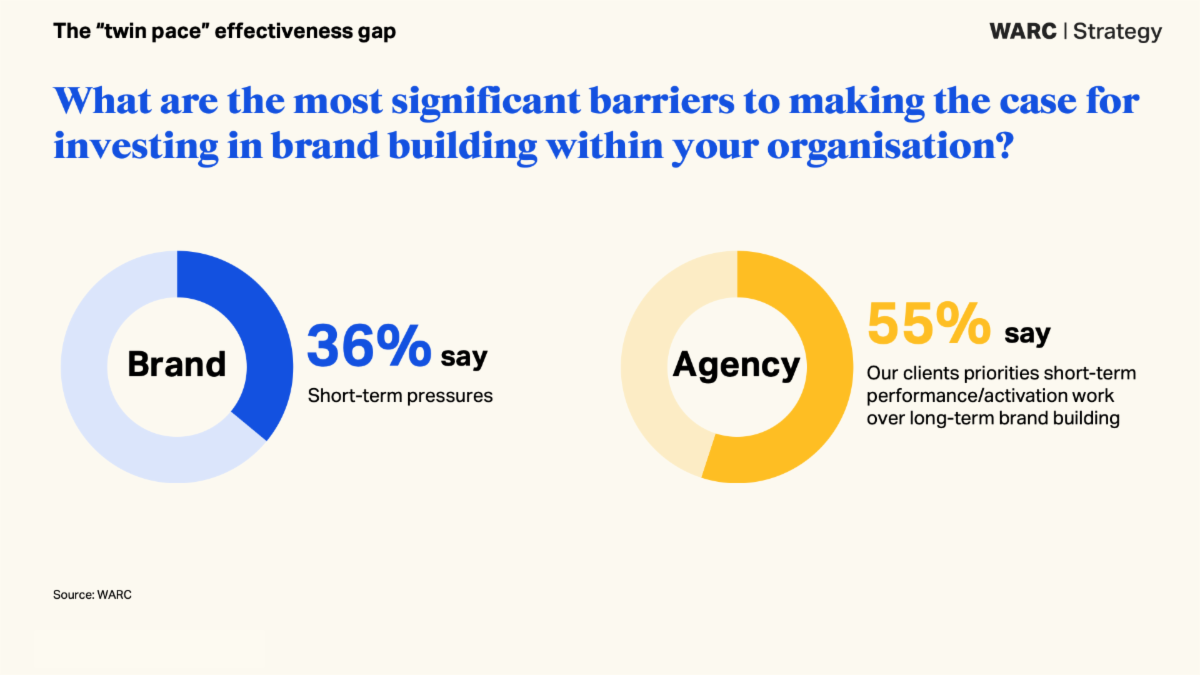
Over a third (36%) of brands identify short-term pressures as a barrier to brand investment, while more than half (55%) of agencies report clients prioritizing short-term activation over long-term brand building
For decades, growth in APAC was structurally abundant, making operational speed and short-term performance reliable strategies for success. Short-term metrics worked because returns surfaced quickly in expanding markets. Today, growth is slower and more competitive, but many organisations are still optimised for a high-growth era that no longer exists. This creates a mismatch between how growth now happens and how decisions are still made.
|